
Somewhere on your engineer’s drawing, your builder’s quote or the docket that arrives with the truck, there is a number followed by the letters MPa. It might appear as 25 MPa, or as N25, or simply as a grade. Most people ordering concrete for the first time treat it as a quality rating, assume bigger is better, and move on.
It is not a quality rating. It is a specific, measured, contractually meaningful figure, and understanding what it describes will tell you why your slab was specified the way it was.
What the number actually measures
MPa stands for megapascals, a unit of pressure. In concrete, it refers to characteristic compressive strength: the load a sample can carry, per unit of area, before it crushes.
The word characteristic is doing quiet but important work there. It does not mean average. It is a statistical value set so that only a small proportion of test results would be expected to fall below it. When a mix is described as 32 MPa, the plant is not aiming for 32 and hoping. It is designed to comfortably exceed it, because the specified figure is effectively a floor rather than a target.
The number is also tied to a moment in time. Compressive strength is verified on test cylinders cured under controlled conditions and crushed at 28 days. That is the industry reference point, not the day your slab becomes usable, and the two get confused constantly.
The four grades you will see most often
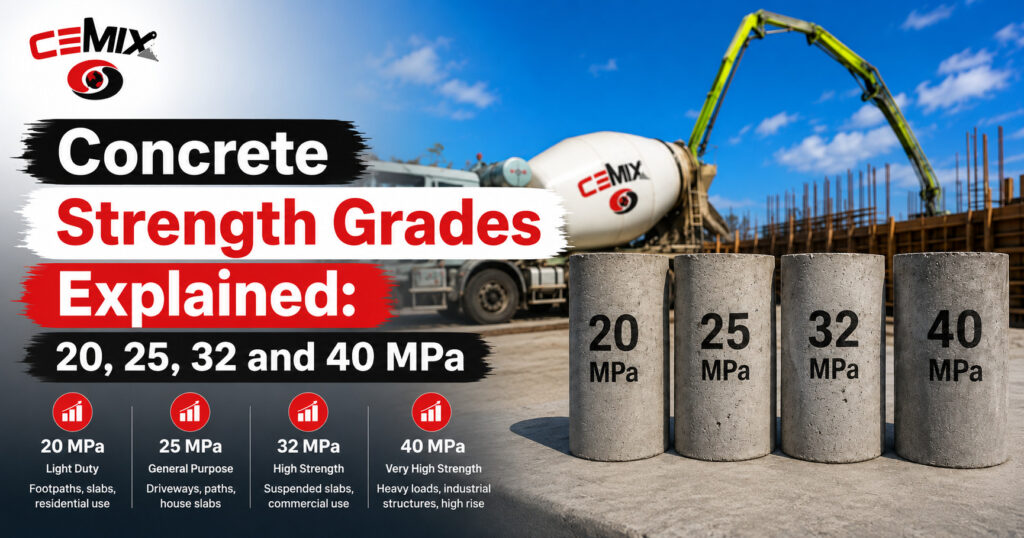
Under AS 1379, the Australian Standard covering the specification and supply of concrete, the common residential and light commercial grades run N20, N25, N32 and N40. The N marks them as normal class concrete, which means the mix is defined by a short set of standard parameters rather than a bespoke design.
- N20 sits at the lower end of structural use and turns up in footings, fill and non-critical work where the concrete is protected from the weather.
- N25 is the workhorse of residential construction and appears across a great many house slabs and footings.
- N32 steps up where the concrete is exposed to weather or carries traffic, which is why it is common on driveways, external paving and garage slabs.
- N40 belongs to heavier-duty work, aggressive exposure conditions and situations where the designer wants a denser, less permeable concrete.
Where your job lands is a decision for your engineer or the specification you are building to, not a matter of preference. AS 2870, which governs residential slabs and footings, sets a minimum for domestic work, and your engineer may specify above that minimum for reasons particular to your site.
Exposure usually matters more than load
This is the part that surprises people. On a typical house slab, the concrete is nowhere near its compressive limit. A residential floor slab is not being crushed by furniture. So why specify a higher grade?
Because strength grade is a proxy for density. Achieving a higher grade requires a lower water-to-cement ratio, and a lower water-to-cement ratio produces a tighter, less porous concrete. Less porous concrete resists the ingress of water, chlorides and sulphates, which is what actually destroys concrete over decades by corroding the steel inside it.
AS 3600, the standard covering concrete structures, formalises this by linking exposure classification to a minimum strength grade. A slab enclosed inside a house sits in a benign environment. A driveway exposed to rain and sun, a coastal application, or concrete in contact with aggressive soils each move up the scale. The grade rises not because the loads increase, but because the environment is more hostile.
Higher is not automatically better
There is a real temptation to over-specify on the theory that stronger concrete cannot hurt. It can.
Higher grades generally carry a higher cementitious content, and cement paste is the component that shrinks as concrete dries. More paste can mean more drying shrinkage, and drying shrinkage is a leading cause of the cracking that homeowners find so frustrating. Richer mixes can also set faster, which shortens the window available for finishing and makes life harder on a hot, windy Melbourne day.
Upgrading a grade without a reason from the design is not free insurance. It is a trade-off, and it should be a deliberate one.
Grade is only one of four things on the order
A normal class order is not complete with a strength grade alone. The standard defines a normal class mix by four parameters, and leaving any of them to chance invites a delivery that is technically correct and practically unusable.
- Strength grade, as discussed above.
- Slump, which describes the consistency of the fresh concrete and should suit the placement method and the finish.
- Maximum nominal aggregate size, which is governed by section thickness, reinforcement spacing and whether the concrete is being pumped.
- Intended method of placement, because concrete destined for a pump line has different requirements to concrete going down a chute.
When your job leaves normal class behind
Some jobs cannot be described by those four parameters. If a designer needs a controlled shrinkage limit, a specified flexural strength, a particular cement replacement, a defined durability performance or a colour, the order moves into special class concrete, where the mix is designed against the nominated properties instead.
Products built around a specific behaviour rather than a strength target sit outside the normal class framework too. Permeable concrete is a good example, since its open structure is the entire point of it and a conventional grade comparison tells you very little about whether it suits the application.
What to do with the number on your plan
Read it exactly as written and pass it on exactly as written. Do not round it, translate it into a description, or substitute the grade a neighbour used on a similar job. If the plan and the quote disagree, resolve that before pour day rather than on it, because once concrete is batched to a grade it cannot be changed in the truck.
Frequently asked questions
What does the N in N25 stand for?
It designates normal class concrete under AS 1379, and the number that follows is the characteristic compressive strength in megapascals. So N25 and 25 MPa normal class describe the same product. An S prefix indicates a special class, where the mix is defined by nominated properties rather than the standard parameter set.
Is stronger concrete more resistant to cracking?
Not reliably. Compressive strength and cracking resistance are different properties. Most cracking in residential work comes from drying shrinkage, restraint and control joint placement rather than from the concrete being overloaded. A higher grade can even increase shrinkage potential. Joint layout, curing and reinforcement detailing do more for crack control than the grade does.
Can I use my slab as soon as it reaches 28 days?
The 28-day figure is a verification benchmark for testing, not a schedule for site activity. Concrete continues gaining strength well beyond it, and it is usable long before it. When you can walk on it, load it, or drive on it depends on the mix, the weather, the curing and what the structural design requires. Ask your engineer or builder for the actual sequence.
The plan says 32 MPa but nothing about slump. Is that enough to order?
No. Ordering on grade alone means someone else is choosing your slump, aggregate size and placement assumption by default. Go back to whoever produced the specification and get the remaining parameters confirmed in writing. It takes one phone call and prevents a delivery that cannot be placed the way you intended.
Does a higher grade change how long I have to finish the surface?
It can. Richer mixes tend to stiffen sooner, and in hot or windy conditions that window shrinks further. If you are upgrading a grade, tell whoever is finishing the concrete so they can plan crew numbers and timing accordingly.
Send us the specification, not your best guess
If you have a drawing, an engineering detail or a builder’s quote with a grade on it, the simplest thing you can do is send it through and let us read it. Our team will confirm the grade, slump, aggregate size and placement method against what is written, and flag anything that looks inconsistent before it becomes a problem on site. Guessing a grade is the one part of a concrete order that cannot be corrected once the truck leaves the plant, so get in touch while the paperwork is still in front of you.
Whittlesea plant
0481 837 000 | 2410 Plenty Rd, Whittlesea VIC 3757
Somerton plant
0409 461 990 | 116-122 Somerton Rd, Somerton VIC 3062
Email enquiry@cemixvic.com.au | Web cemixvic.com.au
Open 7 am to 5 pm, Sunday 8 am to 3 pm, with special service on demand.