
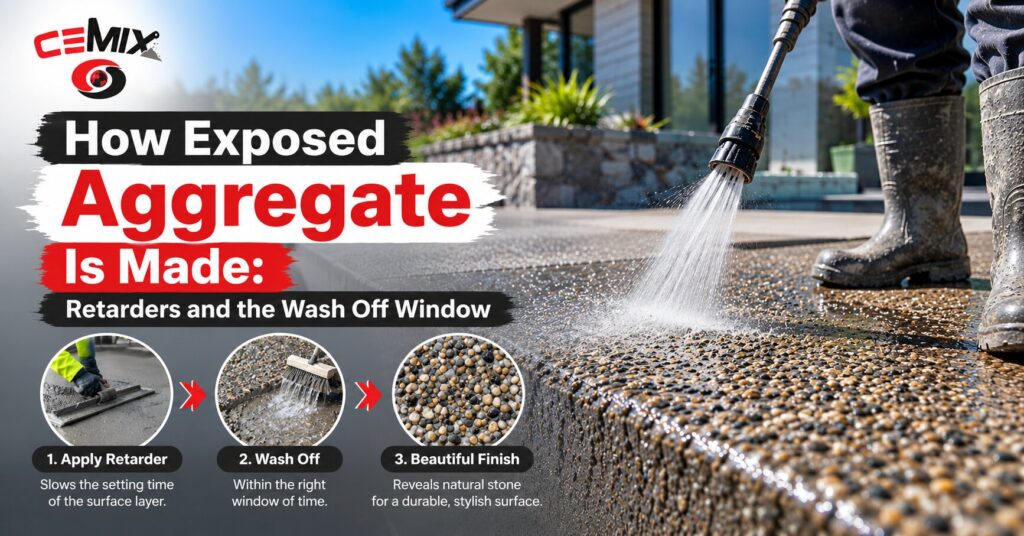
Exposed aggregate is the least forgiving finish in residential concreting. A plain slab hides a multitude of small process errors under a trowelled surface. An exposed finish puts every one of them on display, permanently, at eye level, across the most visible piece of hard landscaping on the property.
The finish itself is simple enough to describe. You remove the cement paste from the top few millimetres so the stone underneath shows. Everything difficult about it is timing.
Four routes to the same look, and they are not interchangeable
- Chemical retarder. A surface retarder is sprayed onto the fresh concrete after finishing. It suppresses hydration of the paste at the surface only, while the concrete below sets normally. The retarded layer is washed away the following day.
- Water wash back. No chemistry. The surface is washed and brushed once the concrete has stiffened enough to hold the stone but not so much that the paste has hardened. Cheaper, and a far narrower window.
- Mechanical exposure. Grinding, polishing or abrasive blasting after the concrete has hardened. Different appearance, because it cuts through the stone rather than around it.
- Seeded aggregate. Decorative stone is broadcast onto the surface and floated in, then exposed by one of the methods above. Used where the stone in the mix is not the stone you want to see.
The route should be chosen before the mix is ordered, not on the day. It affects the aggregate selection, the finishing sequence and how the exposed concrete is specified at the plant.
Match the etch depth to the aggregate, not to the look you want
Surface retarders are supplied in graded strengths, each corresponding to an approximate depth of paste removal. The retarder grade has to be matched to the nominal aggregate size in the mix.
Go too shallow, and the stone is barely revealed, which reads as a dirty slab rather than a decorative finish. Go too deep, and you remove more paste than is holding the stone in place. The aggregate loosens, pops out under traffic, and leaves pockmarks that cannot be repaired invisibly.
A useful discipline is to treat etch depth as roughly one third of the stone diameter. Enough to reveal the shape, not enough to undermine it.
Most exposed aggregate failures happen before the retarder goes on
Two things ruin a job well before anyone reaches for a spray unit.
The first is inconsistent concrete. Batch-to-batch variation that would be invisible in a trowelled slab shows up in an exposed finish as banding and colour shift, because you are looking directly at the aggregate distribution and the residual paste colour. Order the full quantity for a continuous area from one plant, on one day, and keep the loads moving so there is no extended gap between them. Water added on site is the worst offender here, since it changes both the paste colour and the way the stone sits.
The second is over-working the surface. Every extra pass with a float draws paste and fines upward and pushes the stone down. On a plain slab, that is exactly what you want. On an exposed slab, you are burying the thing you intend to reveal, and no retarder will bring it back evenly. Screed, bull float, then stop.
The wash-off window
This is the part that separates operators who do exposed aggregate occasionally from those who do it routinely.
The retarder holds the surface paste soft for a limited period. Wash too early and the concrete beneath has not developed enough strength to grip the stone, so the aggregate dislodges. Wash too late and the retarder has been overcome by ongoing hydration, leaving a surface that resists pressure washing and exposes unevenly where you have had to work harder in places.
The window is not a fixed number of hours. It moves with ambient temperature, the cement content of the mix, the retarder grade, wind, humidity and how much sun the slab caught in the afternoon. Manufacturers publish guidance ranges, and those ranges assume conditions that a Melbourne spring rarely delivers.
Melbourne conditions worth planning around
In the northern corridor, the practical issues are cold nights and unpredictable rain.
A cold night slows hydration and stretches the window, which sounds helpful until a crew arrives at the usual hour and finds the surface still too green to wash. A hot northerly does the opposite and can close the window before the next morning.
Rain landing on a retarded surface overnight is the classic disaster. It washes the retarder unevenly, scours channels into the soft paste and leaves a result that cannot be corrected. If there is rain in the forecast, either protect the surface properly or move the pour.
Where the wash water goes
Wash-off slurry is alkaline and carries a heavy load of cement fines. In Victoria, it must not enter the stormwater system, and the general environmental duty places responsibility on the person doing the work, not on the supplier.
Plan containment before the truck arrives. Bund the perimeter, direct runoff to a contained area or a settling point, and have a plan for the residue. Retrofitting this at seven in the morning with water already running toward a kerb inlet does not work.
Cure first, seal later
Once the surface has been washed and the aggregate revealed, the concrete still needs curing. The exposed surface has just lost its paste layer and is more open than a trowelled one.
Sealing comes later, after the surface has dried properly and any efflorescence has been dealt with. Sealing a damp slab traps moisture and produces the milky blush that turns up on so many driveways within a fortnight. The same rule applies to decorative and coloured concrete, where a premature seal can lock in mottling that would otherwise have faded.
Control joints have not gone anywhere either. An exposed finish does nothing to change shrinkage behaviour, and joints still need to be cut on time.
Frequently asked questions
Can patchy exposure be corrected after wash-off?
Partially, and rarely well. Light areas can sometimes be worked further while the surface is still soft, but once the concrete has hardened, the options are mechanical, which changes the appearance of the whole panel. Grinding a patch to match a washed finish is not realistic. Prevention through even retarder application and consistent finishing is the only reliable approach.
Do I actually need a retarder, or can I just wash back?
Water wash back works, and plenty of good work has been done that way. What you give up is control. Without a retarder, the window is short, and it closes at a rate set by the weather rather than by a product you have selected. On a large area, or on a job where the crew cannot return at an arbitrary hour, a retarder is the safer choice.
How long should I wait before sealing?
Long enough that the slab is genuinely dry through the surface layer, which after washing takes longer than people expect and varies enormously with season. Follow the sealer manufacturer’s stated conditions rather than a rule of thumb, and check for efflorescence before committing. Sealing over a bloom locks it in permanently.
Will efflorescence come through an exposed finish?
It can. Efflorescence is salts carried to the surface by moisture moving through the concrete, and an open exposed surface gives it an easy path. It is usually cosmetic and often diminishes over the first year. Consistent curing and adequate drainage under the slab reduce it. A breathable sealer choice matters if the slab sits over damp ground.
Does the aggregate choice change how the concrete is ordered?
Yes. The stone you intend to see has to be in the mix, at a size and colour that suits the etch depth you are planning. That is a specification conversation with the plant before the order, not a variation you can request when the agitator is on site.
Talk to the plant before you pick a retarder grade
Etch depth, aggregate size and mix consistency are one decision, not three. If you tell us the finish you are aiming for and the area you are pouring in one hit, we can advise on the aggregate, keep the loads consistent across the pour, and point you to the retarders and sealers that suit the stone you have chosen. Trade enquiries are welcome early, and a five minute call before ordering saves a driveway that has to be looked at every day for twenty years.
Somerton plant
0409 461 990 | 116-122 Somerton Rd, Somerton VIC 3062
Whittlesea plant
0481 837 000 | 2410 Plenty Rd, Whittlesea VIC 3757
Email enquiry@cemixvic.com.au | Web cemixvic.com.au
Open 7 am to 5 pm, Sunday 8 am to 3 pm, with special service on demand.