
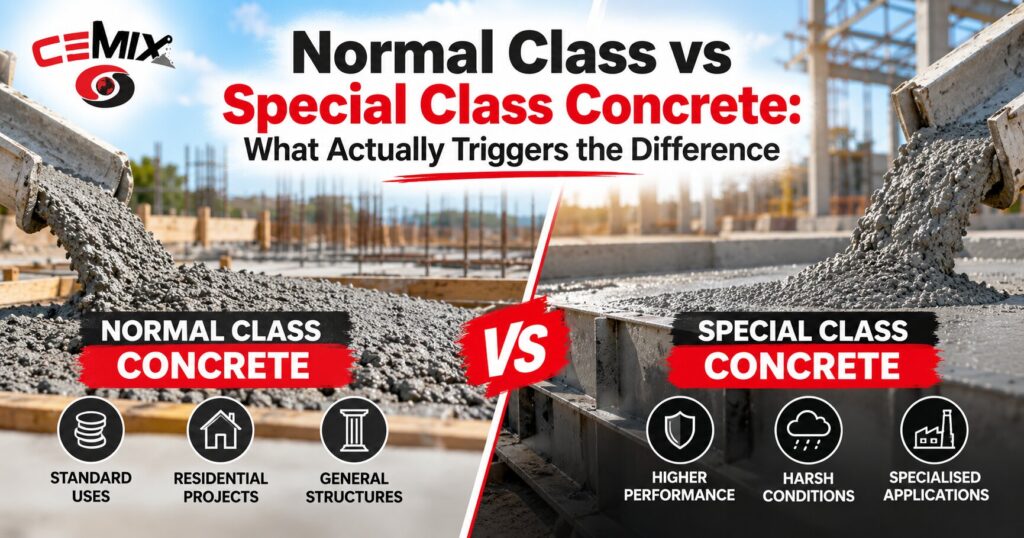
There is a persistent belief on residential sites that special-class concrete is the good stuff. The premium option. The mix you order when the job really matters.
It is not. AS 1379 splits concrete supply into two categories, and the split is about how the concrete is defined, not how good it is. A normal class mix can be entirely appropriate for a job where a special class mix would be pointless, and the reverse is equally true. Knowing which side your job sits on determines how far ahead you need to order and who is responsible for the mix performing.
What a normal class order actually commits the plant to
When you order normal class concrete, you are choosing from a short, standardised set of parameters. Strength grade, slump, maximum nominal aggregate size and the intended method of placement. Everything else, including the mix proportions and how compliance is assessed, follows the default provisions in the standard.
That is a genuine advantage. It is a shorthand that both parties understand; it is repeatable across plants, and it means you do not need a materials engineer to buy concrete for a shed slab. The trade-off is that you are limited to what those four parameters can describe.
What pushes a job into special class
The moment a specification asks for something those four parameters cannot express, the order becomes special class concrete. Common triggers include:
- A limit on drying shrinkage, which matters where cracking control is critical.
- A specified flexural strength rather than compressive strength, which is common in pavement work.
- Strength nominated at an age other than the standard test age, often where supplementary cementitious materials are used.
- A particular binder, such as a nominated proportion of fly ash or slag, or a cement chosen for sulphate resistance.
- A durability or permeability requirement tied to an exposure condition.
- Colour, oxide or a specific decorative aggregate.
- Fibre reinforcement.
- Controlled setting behaviour, such as a retarded mix for a long haul or a continuous pour, or an accelerated mix in cold conditions.
- Unusual workability requirements, including self-compacting concrete or mixes designed for long pump lines.
- A nominated density, above or below the normal range.
Notice how many of these have nothing to do with strength. That is the point. Special class exists because concrete has properties beyond compressive strength that a designer sometimes needs to control directly.
Some products are special class by nature
A few mixes cannot be described in normal class terms at all, because the behaviour the job needs is the thing being specified.
Block fill and kerb mix are good examples. Block fill has to flow into narrow masonry cores and fill them completely without segregating, which is a workability requirement first and a strength requirement second. Kerb mix goes the other way, needing to hold its shape the moment it leaves the machine.
Shotcrete is designed around being pumped through a line and sprayed at velocity onto a surface where it has to stay put. None of that is captured by a grade and a slump.
Permeable concrete and decorative mixes fall into the same category. In each case the defining property is the job the concrete has to do, not a number on a cylinder.
Who decides, and who carries the risk
This is the part worth understanding before you order.
With a normal class mix, you nominate from a standard set, and the supplier is responsible for meeting those standard requirements. With a special class mix, the purchaser or their designer nominates the properties, and the supplier produces concrete to meet the nominated properties. Responsibility for whether those properties are the right ones for the application sits with whoever specified them.
In practice, that means special class is a conversation between your engineer and the plant, with you in the middle passing information accurately. It is not a box to tick because the job feels important.
What changes practically when you order it
- Lead time. A special class mix may need to be designed, and in some cases trialled, before it can be supplied. That is not a next-day process.
- Purpose-designed mixes are less flexible on small or partial loads than a standard grade.
- The nominated properties should be in writing, from the specification, before the order is placed.
- No changes on the day. You cannot convert a normal class order into a special class one while the truck is on its way, and you cannot add colour or fibre to a load that has already been batched to a different specification.
The short answer
Normal class means the concrete is described by a standard shorthand. Special class means it is described by the properties it has to deliver. Neither is a grade of quality. Most residential work sits comfortably in normal class, and the jobs that do not usually know it already, because someone has written the requirement down.
Frequently asked questions
Is special class concrete stronger than normal class?
Not inherently. Special class describes how the concrete is specified, not its strength. A special class mix might be designed around shrinkage, colour, density or flow behaviour and have a compressive strength similar to a common normal class grade. Asking for special class will not make a slab stronger unless strength is one of the properties being nominated.
I want oxide colour in my driveway. Does that make it special class?
Yes. Colour is not one of the parameters that defines a normal class mix, so a coloured order is specified differently. It also introduces batch consistency considerations, since colour variation between loads is visible in a way that strength variation is not. Order the full quantity for a continuous area at the same time.
Can I upgrade from normal class to special class after placing the order?
Before batching, sometimes, depending on the mix and the notice given. Once a load is batched, no. The mix in the drum was proportioned for a particular specification, and nothing useful can be added to change that on site. If your specification is still being finalised, delay the order rather than placing a provisional one.
If a special class mix does not perform, whose problem is it?
It depends on whether the concrete met the nominated properties. A supplier is responsible for supplying concrete that complies with the specification given to them. Whether that specification suited the application is a question for whoever wrote it. This is exactly why the nominated properties should be documented before the order rather than agreed over the phone.
Does special class concrete require different testing?
It can. Where a purchaser nominates properties beyond the standard set, the testing and acceptance arrangements that apply to those properties are part of what gets specified. Discuss sampling and testing expectations with your engineer and the plant at the same time you discuss the mix, not after delivery.
Describe the job, not the mix
The most useful call you can make is the one where you describe what the concrete has to do rather than what you think it should be called. Tell us the application, the conditions, the finish you want and anything your engineer has written down, and we will tell you whether a standard normal class grade covers it or whether the job genuinely needs a designed mix. Getting that question answered a week out costs nothing. Getting it wrong on delivery day costs a pour.
Whittlesea plant
0481 837 000 | 2410 Plenty Rd, Whittlesea VIC 3757
Somerton plant
0409 461 990 | 116-122 Somerton Rd, Somerton VIC 3062
Email enquiry@cemixvic.com.au | Web cemixvic.com.au
Open 7am to 5pm, Sunday 8am to 3pm, with special service on demand.